
Schools and colleges are often perceived as low-risk environments. They are associated with classrooms, offices, safeguarding policies, and academic leadership — not hard hats and hazard signage.
Many leaders in education have built their careers in teaching, curriculum design, pastoral care, and institutional management. They are highly trained in pedagogy, leadership, and safeguarding.
But can safeguarding stop at the classroom door?
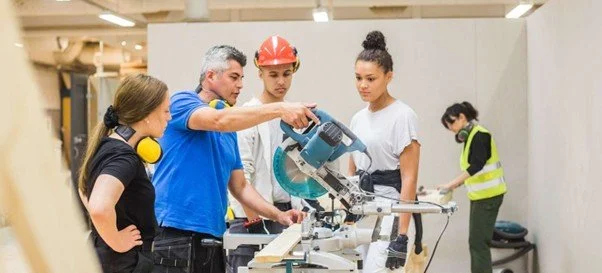
When “Low Risk” Isn’t Low Risk
Modern education increasingly includes vocational and technical pathways. Colleges delivering construction, engineering, motor vehicle, hair and beauty, catering, or agricultural courses expose students to very real hazards:
Cement and silica dust
Noise and vibration
Moving machinery
Manual handling risks
Hazardous substances
Work at height
Live construction environments
These are not theoretical risks. They are the same hazards found on active sites regulated by the Health and Safety Executive under legislation such as the Health and Safety at Work etc. Act 1974 and the Control of Substances Hazardous to Health Regulations 2002.
In these settings, misunderstanding risk is not just an administrative oversight — it can lead to life-changing injuries, enforcement notices, prosecution, reputational damage, and long-term health consequences for young people at the very start of their working lives.
The Leadership Gap
Here lies the uncomfortable question:
Is it fair — or safe — to expect senior leaders in education to sign off on health and safety decisions in high-risk vocational environments when they have never worked in those industries themselves?
Many educational leaders:
Have deep classroom experience
Understand safeguarding and governance
Are trained in policy and compliance
But they may not:
Recognise the long-term impact of silica exposure
Understand hand-arm vibration syndrome
Appreciate the hierarchy of control in construction settings
Know what “good” actually looks like in a workshop risk assessment
And the challenge is this: you cannot manage what you do not understand.
Often, operational responsibility is delegated to middle managers or curriculum leads who may also lack formal health and safety competence. Risk assessments become paperwork exercises. Senior leaders sign them off without fully understanding the control measures — because they trust the system.
Until something goes wrong.
The Real-World Consequence
Students on vocational programmes are not just learners — they are future workers. The standards and habits they develop in college transfer directly into industry.
If a student learns that:
Dust suppression is optional
PPE is negotiable
Noise exposure is “just part of the job”
Risk assessments are tick-box exercises
They carry those beliefs onto real construction sites.
Poor safety practice does not just risk injury — it risks removal from site, dismissal, or enforcement action.
Educational institutions therefore hold a dual responsibility:
To protect students while they learn.
To model industry-standard safety culture that will follow them for life.
The Myth of “General” Safeguarding
Safeguarding in education traditionally focuses on welfare, mental health, and protection from harm in social contexts. That is vital.
But exposure to respirable crystalline silica without proper controls is also safeguarding. So is preventing early hearing damage. So is ensuring students understand dynamic risk assessment before stepping onto a live site.
Physical health protection is safeguarding.
So How Do We Manage This?
The answer is not to expect headteachers or principals to become construction experts. Nor is it acceptable to leave health and safety entirely to delegated staff without oversight.
Instead, organisations should consider:
1. Competent Advice at Strategic Level
Boards and senior leaders must have access to genuinely competent health and safety advice — not just administrative support. Competence means training, experience, and industry understanding.
2. Targeted Leadership Training
Senior leaders overseeing vocational provision need:
An understanding of key industry hazards
Awareness of legal accountability
Insight into how incidents actually occur
Knowledge of what good risk management looks like in practice
Not technical mastery — but informed oversight.
3. Clear Accountability Structures
Delegation is acceptable. Abdication is not. Roles must be defined so that:
Operational control sits with competent managers.
Strategic oversight remains with leadership.
Governors understand their responsibilities.
4. Industry Alignment
Partnership with employers ensures:
Teaching reflects current site standards.
Students learn realistic safety expectations.
Risk controls mirror real-world practice.
5. Culture Over Paperwork
Risk assessments should be living tools — not archived documents. Safety culture should be visible in workshops, PPE usage, supervision standards, and student behaviour.
A Difficult but Necessary Question
Is it reasonable to ask leaders to sign off on risks they do not fully understand?
The honest answer is no — not without support, training, and competent advice.
But it is entirely reasonable to expect leaders to recognise what they do not know and to seek expertise accordingly.
Because in vocational education, the consequences of ignorance are not abstract. They are measured in injuries, enforcement action, and lost futures.
Final Thought
Schools and colleges may appear low risk from the outside. But where vocational training exists, they are gateways into some of the highest-risk industries in the country.
If we truly believe education prepares young people for the world of work, then safety competence must be treated as seriously as academic achievement.
Safeguarding does not end at the classroom door. In some settings, it starts in the workshop.